
Unlike the American lunar program, which used common hardware for lunar landing and lunar orbital missions, the Soviet Union chose to develop a separate spacecraft with it's own booster for these two missions. The Zond spacecraft, aka Soyuz 7K-L1, was designed to sling a single cosmonaut around the moon and back in a non-orbital loop. The booster chosen to take it to the moon was the then-new Proton. Contrary to the N-1 manned lunar program, the Proton booster worked well but the spacecraft failed in all but one of it's test flights.

Soviet 7-K L1 Zond circumlunar spacecraft at center of
page, attached to it's Block
D trans-lunar injection stage. Around the vehicle is a graphic
depiction of the planned mission.


Above: 3 views of the Proton-Zond launch vehicle on the
pad at Baikonur. Note the fact that a launch escape system (LES)
tower has been added to the top of the spacecraft shroud. The reason
this seems strange is that those of us who were used to thinking of the
Proton as only being used for unmanned launches had only seen this booster
without an LES, which is not needed on unmanned launches.
This booster is now used as a workhorse of the Soviet/Russian
space program, launching all of the Salyut space stations and Mir components,
as well as many commercial payloads. It is still in use today and
is being utilized to launch the larger Russian components of the International
Space Station.
(Note - an excellent resin model
of this booster was available in 1/144 scale from Rho Models, but sadly
that company which was owned by my friend Julius deRoo, has folded.
It can now be bought from RealSpace
Models)
For more detailed information on this program, I highly
recommend
Mark Wade's Encyclopedia
Astronautica web site.
Zond Spacecraft
An excellent resin model
kit of the Zond spacecraft is now available from New
Ware Models.
Update: I bought and built one of the New Ware Zond kits.
You can see it here
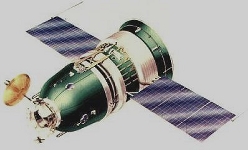

Two artist's impressions of Zond spacecraft. Essentially
a souped-up Soyuz vehicle without the round Orbital Module at the front.
A collar was added in it's place to allow for the mounting of a high gain
antenna and attachment of the spacecraft to the launch shroud.
Compare this to the LOK
spacecraft which was built to carry a lunar landing crew to the moon.

Zond spacecraft mated with it's Block D stage (under silver fairing) and core of Proton booster.
Zond Today
Two of the Zond descent modules survive today and are on display at
museums inside Russia. Zond 5 is at the Energia Museum and Zond 7
is at Orevo.
Julius deRoo was kind enough to send me these photos (Thanks
as always, Julius!)
Zond 7


